
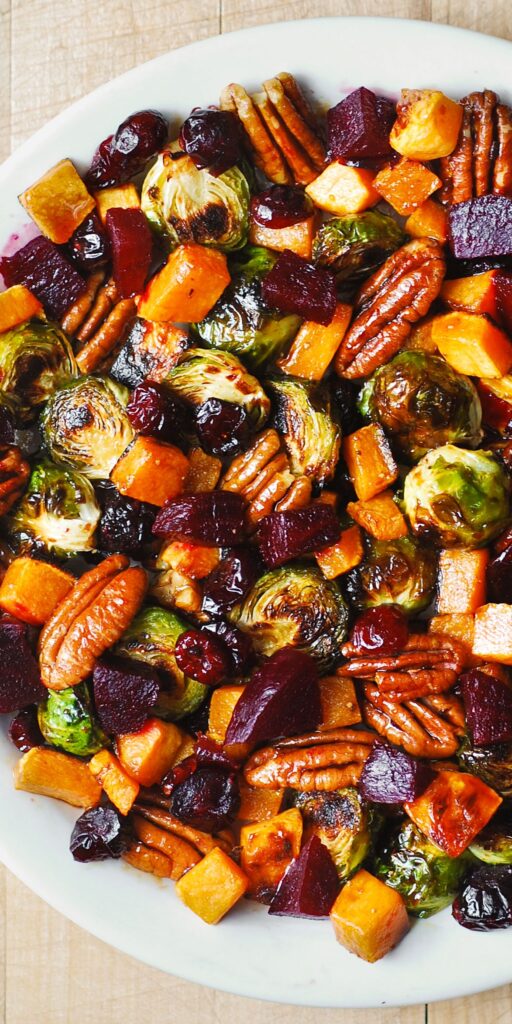
Winter Vegetable Salad with Roasted Butternut Squash, Brussels Sprouts, and Beets solves a specific problem: cold-weather produce that tastes flat when eaten raw. Roasting at 425F (220C) for 30 to 35 minutes concentrates sugars through Maillard browning, and the numbers back it up. A raw cubed beet runs about 43 calories per 100g with a firm, earthy bite; roasted, it turns tender and sweet enough to carry a salad without added sugar.
Advertisements1
The architecture matters more than the ingredient list. Squash, sprouts, and beets have different densities and water contents, so they cannot share one tray at one time without turning to mush or staying raw. I split them across two sheet pans, cut everything to a uniform 1-inch (2.5cm) cube, and stagger the timing. The result is a salad where every component is cooked to its own correct doneness, then tossed warm with a maple-Dijon vinaigrette that clings instead of pooling.
Total active work is roughly 15 minutes. The oven does the rest. Serve it warm, at room temperature, or cold the next day; it holds up because there is no delicate lettuce to wilt. One batch feeds 6 as a side or 4 as a main with added protein.
Keep it simple, keep it growing.
Why You'll Love This Recipe
About the Ingredients
1 medium butternut squash (about 2.5 lb / 1.1kg), peeled, seeded, cut into 1-inch (2.5cm) cubes
Look for a squash with a dry, matte skin and a solid, heavy feel; a glossy skin usually means it was picked early and will taste watery. Substitute delicata or honeynut squash, which you can leave unpeeled and which roast in about 20 minutes instead of 30.
1 lb (450g) Brussels sprouts, trimmed and halved lengthwise
Buy sprouts that are tight, bright green, and roughly golf-ball sized; larger ones turn bitter and woody. If you can only find large sprouts, quarter them so they cook in the same window.
3 medium beets (about 1 lb / 450g), peeled and cut into 1-inch (2.5cm) cubes
Golden or Chioggia beets bleed less and keep the salad looking clean; red beets taste identical but will stain the sprouts pink. Wear gloves when peeling red beets or your hands stay pink for hours.
3 tbsp (45ml) extra-virgin olive oil, divided
Use a mid-range oil for roasting and save your expensive finishing oil for the dressing. Avocado oil works as a neutral, higher-smoke-point substitute at 425F (220C).
2 tbsp (30ml) pure maple syrup
Grade A dark or Grade B maple has more caramel flavor than light amber. Honey is a direct 1:1 substitute, though it browns slightly faster, so check the sprouts at 25 minutes.
1 tbsp (15ml) Dijon mustard
Dijon emulsifies the vinaigrette so it coats rather than separates. Whole-grain mustard gives a coarser texture and a milder bite if you prefer less sharpness.
1 tbsp (15ml) apple cider vinegar
Cider vinegar is milder than white vinegar and pairs with the beets. Lemon juice plus 1/4 tsp sugar is a workable substitute.
1/3 cup (45g) pepitas (pumpkin seeds)
Toast them in a dry skillet over medium heat for 3 to 4 minutes until they pop and smell nutty; raw pepitas taste flat. Walnuts or pecans are fine substitutes but need 6 to 8 minutes to toast.
1/3 cup (40g) crumbled feta cheese
Feta adds salt and acid to balance the sweet roots. For dairy-free, use 1/4 cup (30g) toasted sliced almonds plus an extra pinch of salt.
1/4 cup (10g) fresh flat-leaf parsley, chopped
Parsley adds a clean, peppery finish that cuts the sweetness. Mint or dill both work; use half the amount since their flavors are stronger.
1/2 tsp kosher salt, plus more to taste
Kosher salt dissolves evenly and seasons in layers. If using fine table salt, start with 1/4 tsp, since it is much denser.
1/4 tsp freshly ground black pepper
Fresh-cracked pepper has more aroma than pre-ground. Add half before roasting and half to the finished dressing for a sharper finish.
Tips & Tricks
- Cut everything to the same 1-inch (2.5cm) cube. Uneven pieces are the number one cause of burnt edges and raw centers in the same pan; a ruler is not overkill the first time you make this.
- Do not crowd the pans. Each piece needs air around it to brown; if the vegetables touch, they steam. Use two large sheet pans and spread them in a single layer, even if it means using a third pan.
- Roast the beets on their own pan. Beets release more moisture and sugar than squash or sprouts, and they will scorch and stain the other vegetables if combined.
- Dress the salad while the vegetables are still warm. Warm vegetables absorb vinaigrette instead of letting it slide to the bottom of the bowl; 2 to 3 minutes out of the oven is the sweet spot.
Pro Tips
Step-by-Step Instructions
1. Preheat and position racks
Set the oven to 425F (220C) with racks in the upper and lower thirds. Place two large rimmed sheet pans in the oven to preheat for 5 minutes; a hot pan starts browning the moment the vegetables land.
2. Season the squash and sprouts
In a large bowl, toss the squash and Brussels sprouts with 2 tbsp (30ml) olive oil, 1/2 tsp kosher salt, and 1/4 tsp pepper. Spread them in a single layer on one preheated pan, cut sides of the sprouts facing down.
3. Season the beets separately
In the same bowl, toss the beets with the remaining 1 tbsp (15ml) olive oil and a pinch of salt. Spread them on the second preheated pan in a single layer, keeping them apart from each other.
4. Roast the beets
Roast the beets on the lower rack at 425F (220C) for 30 to 35 minutes, stirring once at the 20-minute mark. They are done when a knife slides in with no resistance and the edges look dry and slightly shriveled.
5. Roast the squash and sprouts
Roast the squash and sprouts on the upper rack at 425F (220C) for 28 to 32 minutes, flipping once at 18 minutes. Done means the squash is golden brown at the edges and tender at the center, and the sprout leaves are dark and crispy.
6. Whisk the vinaigrette
While the vegetables roast, whisk the maple syrup, Dijon, cider vinegar, and a pinch of salt in a large serving bowl until smooth and slightly thickened, about 30 seconds. It should look glossy, not separated.
7. Toast the pepitas
Heat a dry skillet over medium heat and toast the pepitas for 3 to 4 minutes, shaking the pan often, until they smell nutty and start to pop. Remove them immediately; they go from toasted to burnt in under 60 seconds.
8. Toss and finish
Add the warm roasted vegetables to the vinaigrette and toss gently to coat. Fold in the parsley, then top with the feta and toasted pepitas. Taste and add salt only after the feta goes in, since it is already salty.
Delicious Variations
Add protein
Fold in 2 cups (300g) of shredded rotisserie chicken or 1 1/2 cups (250g) of cooked farro to turn this into a 4-serving main dish.
Maple-balsamic swap
Replace the cider vinegar and maple with 2 tbsp (30ml) balsamic vinegar and 1 tbsp (15ml) honey for a darker, more acidic dressing that suits red beets.
Spicy version
Add 1/2 tsp smoked paprika and 1/4 tsp cayenne to the squash and sprouts before roasting, and finish with a squeeze of lime instead of extra salt.
How to Store Winter Vegetable Salad with Roasted Butternut Squash, Brussels Sprouts, and Beets
Refrigerator
Store in an airtight container for up to 4 days. The vegetables soften slightly each day, so keep the feta and pepitas separate and add them just before serving.
Freezer
Freezing is not recommended for the dressed salad; the vegetables turn watery and the vinaigrette separates. You can freeze the plain roasted vegetables for up to 2 months and dress them after thawing.
Reheating
Reheat undressed roasted vegetables in a 375F (190C) oven for 8 to 10 minutes, or in a skillet over medium heat for 5 minutes, to restore crispy edges. Do not microwave them; they steam and go limp.
Frequently Asked Questions
Q: Can I roast the butternut squash, Brussels sprouts, and beets on the same pan?
You can, but the results are worse because the three vegetables release different amounts of moisture and cook at different rates. Beets need 30 to 35 minutes, squash needs 28 to 32, and sprouts need 25 to 30, so combining them means something is always over or underdone. Use two pans and stagger the timing if you want the best texture.
Q: How do I keep roasted Brussels sprouts from getting mushy?
Dry them thoroughly after washing and give them space on the pan so they roast instead of steam. Cut them in half, place them cut-side down on a preheated pan at 425F (220C), and do not stir them for the first 18 minutes. Crowding and moisture are the two causes of mushy sprouts, not the cooking time.
Q: Can I make this winter vegetable salad ahead of time?
Yes, and it is one of the better make-ahead salads because there is no lettuce to wilt. Roast the vegetables up to 3 days ahead, store them undressed, and toss with the vinaigrette while reheated or at room temperature. Add the feta and pepitas the day you serve so they stay crisp.
Q: What can I use instead of feta to make this salad dairy-free?
Toasted sliced almonds or a tablespoon of nutritional yeast both work as dairy-free replacements. Use 1/4 cup (30g) of almonds for texture and add an extra pinch of kosher salt, since you are losing the salt that feta provides. The salad still has plenty of acid and sweetness without the cheese.
Q: Is this salad served warm or cold?
It works both ways, but warm is best because the vegetables absorb the vinaigrette instead of letting it pool. Serve within 10 minutes of tossing for the crispiest sprouts, or chill it for 2 hours for a firmer, more salad-like texture. Room temperature after 30 minutes is the middle ground most people prefer.
Roast the vegetables tonight, toss them warm, and you have a side dish that doubles as lunch for the next three days. If you make it, note your roasting times and pan setup; small oven differences change the numbers more than the recipe does. Keep it simple, keep it growing.
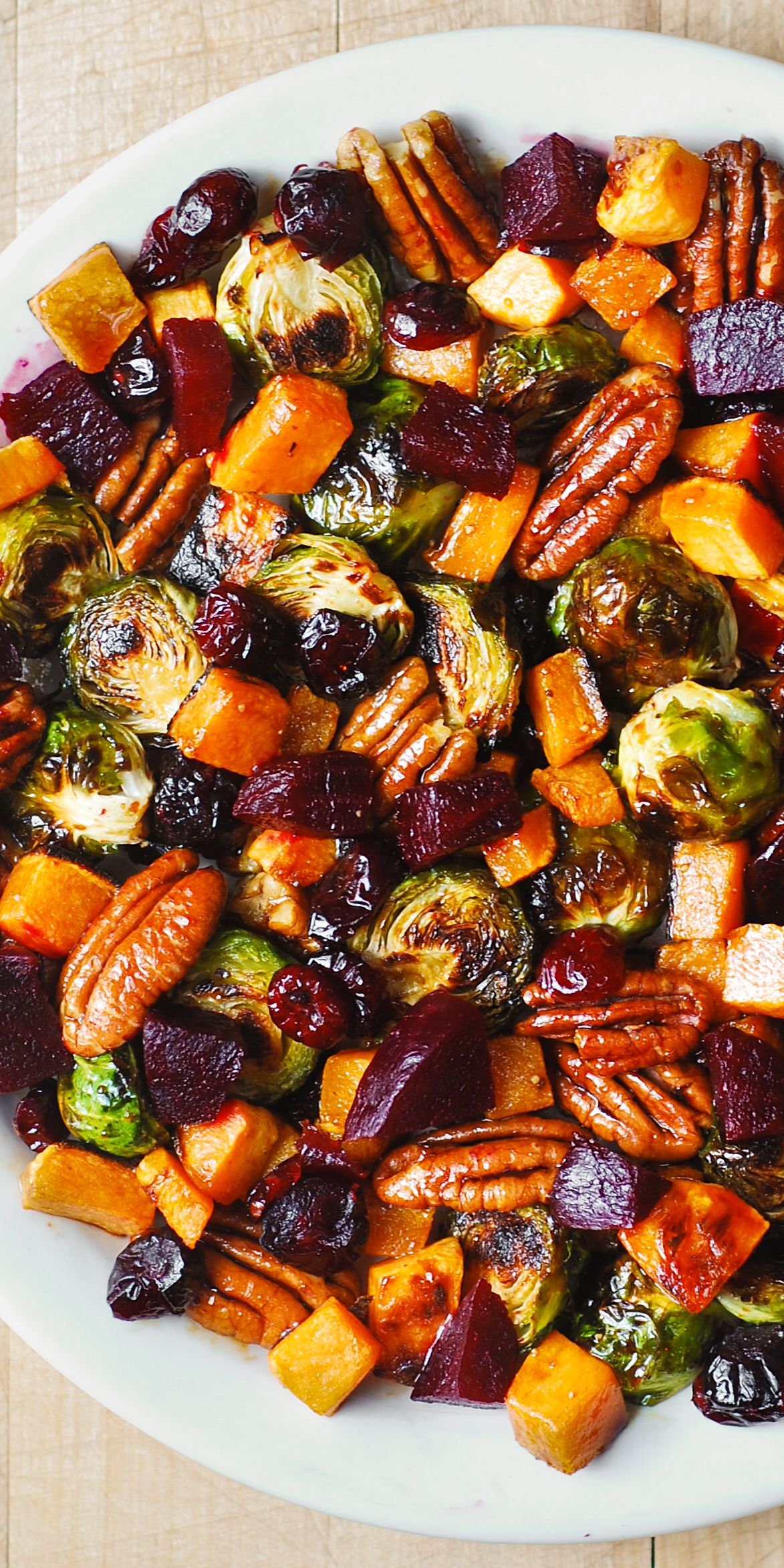
Winter Vegetable Salad with Roasted Butternut Squash, Brussels Sprouts, and Beets
Winter Vegetable Salad with Roasted Butternut Squash, Brussels Sprouts, and Beets delivers 6g fiber per serving and caramelized edges in 50 minutes.
🧂 Ingredients
- 1 medium butternut squash (about 2.5 lb / 1.1kg), peeled, seeded, cut into 1-inch (2.5cm) cubes
- 1 lb (450g) Brussels sprouts, trimmed and halved lengthwise
- 3 medium beets (about 1 lb / 450g), peeled and cut into 1-inch (2.5cm) cubes
- 3 tbsp (45ml) extra-virgin olive oil, divided
- 2 tbsp (30ml) pure maple syrup
- 1 tbsp (15ml) Dijon mustard
- 1 tbsp (15ml) apple cider vinegar
- 1/3 cup (45g) pepitas (pumpkin seeds)
- 1/3 cup (40g) crumbled feta cheese
- 1/4 cup (10g) fresh flat-leaf parsley, chopped
- 1/2 tsp kosher salt, plus more to taste
- 1/4 tsp freshly ground black pepper
📋 Instructions
- 1Preheat and position racks — Set the oven to 425F (220C) with racks in the upper and lower thirds. Place two large rimmed sheet pans in the oven to preheat for 5 minutes; a hot pan starts browning the moment the vegetables land.
- 2Season the squash and sprouts — In a large bowl, toss the squash and Brussels sprouts with 2 tbsp (30ml) olive oil, 1/2 tsp kosher salt, and 1/4 tsp pepper. Spread them in a single layer on one preheated pan, cut sides of the sprouts facing down.
- 3Season the beets separately — In the same bowl, toss the beets with the remaining 1 tbsp (15ml) olive oil and a pinch of salt. Spread them on the second preheated pan in a single layer, keeping them apart from each other.
- 4Roast the beets — Roast the beets on the lower rack at 425F (220C) for 30 to 35 minutes, stirring once at the 20-minute mark. They are done when a knife slides in with no resistance and the edges look dry and slightly shriveled.
- 5Roast the squash and sprouts — Roast the squash and sprouts on the upper rack at 425F (220C) for 28 to 32 minutes, flipping once at 18 minutes. Done means the squash is golden brown at the edges and tender at the center, and the sprout leaves are dark and crispy.
- 6Whisk the vinaigrette — While the vegetables roast, whisk the maple syrup, Dijon, cider vinegar, and a pinch of salt in a large serving bowl until smooth and slightly thickened, about 30 seconds. It should look glossy, not separated.
- 7Toast the pepitas — Heat a dry skillet over medium heat and toast the pepitas for 3 to 4 minutes, shaking the pan often, until they smell nutty and start to pop. Remove them immediately; they go from toasted to burnt in under 60 seconds.
- 8Toss and finish — Add the warm roasted vegetables to the vinaigrette and toss gently to coat. Fold in the parsley, then top with the feta and toasted pepitas. Taste and add salt only after the feta goes in, since it is already salty.

Liam covers personal finance and investing for beginners, demystifying money management with clear, no-nonsense advice. He focuses on budgeting, saving, and long-term wealth building, often using real-life scenarios to illustrate concepts.